


Project name:
Katrina Lee’s 8.3-Star Home
Katrina Lee's 8.3-Star Home, Wagga Wagga
Date completed 2026
Location Wagga Wagga, NSW
Perched in inland New South Wales, Katrina Lee’s new home in Wagga Wagga is a considered response to climate, lifestyle and long-term performance. Katrina, an interior designer with a background in advertising and marketing and a long-standing presence in the Australian design community, approached this build with clarity and intent. In many ways the project is a personification of her industry experience and personal design sensibilities, and was envisioned as a way to apply the skills and lessons from years of designing for others back into her own home.
A defining pillar within that experience is an emphasis on how architecture can directly support lifestyle within a home. Katrina had clear goals of creating a home where the materials, layout and finishes all made the interior feel grounded and calming.
When I started planning our new build, I knew one thing for sure. I wanted this house to feel calm, structured, and healthy. Life gets busy and a home should support you, not drain you. That is what pushed me toward an 8 star energy rating. It is not just a number. It is comfort, wellness, and long term savings wrapped into one smart plan.
– Katrina Lee, My Plan for Building an 8 Star Home and what it really takes


Katrina aimed for the project to achieve an 8.3-star rating under the Nationwide House Energy Rating Scheme (NatHERS). NatHERS ratings reflect how efficiently a home’s design responds to the local climate around it, and it judges the volume of energy required to maintain interior comfort year-round. Homes rated 8 stars and above require low heating and cooling energy, which significantly lowers running costs and environmental impact compared to lower ranked builds. In inland locations like Wagga Wagga where the summers are dry and intensely hot, and winters are crisp, windy and sharp, the choice to include products and systems that support this rating is a forward-thinking way to ensure lower running costs and much higher comfort for decades to come.
NatHERS is Australia’s way of rating how energy-efficient a home’s design is, from 0 to 10 stars. The more stars, the less energy needed to keep your home comfortable all year round. An 8-star rating means my home requires very little heating or cooling to stay comfortable.
– Katrina Lee, How I Achieved an 8-Star NatHERS Rating for My New Home in Australia
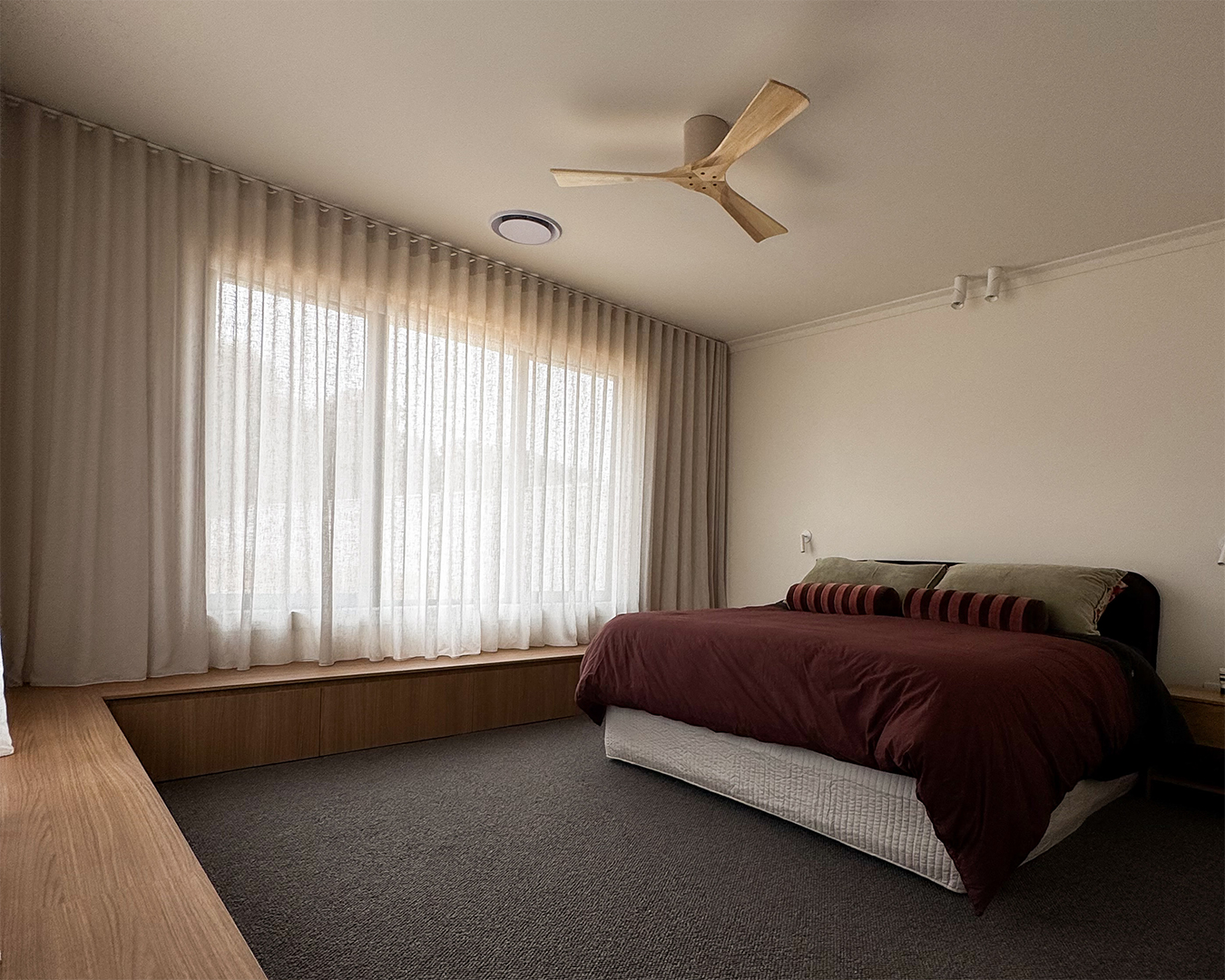

NatHERS itself measures the thermal performance of a construction comparing its orientation, layout, insulation and airflow, modelling how the home will react to seasonal conditions and how much energy it will need to maintain comfort (NatHERS star ratings provide information about the thermal performance of a home). Foundational decisions like optimising the home’s orientation with north-facing living spaces (maximising winter solar gain and mitigating summer heat) were guided by the NatHERS standards.
In a well insulated, airtight build, airflow helps regulate temperature and reduces reliance on heating and cooling…
…Ceiling fans are often treated as a finishing touch, but in an energy efficient home they are an essential part of keeping spaces comfortable.– Katrina Lee, Why Ceiling Fans matter in an energy efficient build.
Achieving the desired interior comfort was a multidimensional undertaking that required an understanding of each layer of the project – from broad concepts like the building envelope, to considerations like thermal mass inside,all the way to smaller elements like glazing performance and controlled ventilation working together as an integrated system. This layered approach also acknowledges that appliances and active systems, while not directly counted toward the NatHERS thermal star, influence overall energy use and occupant comfort.
Within that context, ceiling fans become an important consideration for developing the project’s airflow strategy. For example, well-specified ceiling fans allow the heating and cooling systems to operate less frequently and less intensively without sacrificing comfort. In practice, this means more comfortable rooms with lower running costs and less noise disruption.
The Gaia fans use a DC motor, which is ideal for energy efficient homes. DC motors consume far less power than traditional AC motors while still providing smooth, steady airflow.
– Katrina Lee, Why Ceiling Fans matter in an energy efficient build.


Katrina also embraces thoughtful material choices throughout the project, each chosen to help support the energy-efficiency of the project, or its comfort through aesthetics. One of her blogs, Why We’re Using Timber Frames and LVLs in Our 8-Star Home Build showcases this philosophy, where it explains why timber frames paired with laminated veneer lumber (LVLs) were chosen.
The Fanco EarthFirst Gaia DC features FSC certified timber blades, which resonate with the home’s natural aesthetic and the broader ethos to reduce energy usage. The EarthFirst range are an Australian-first fan family with lower environmental impact as a priority within their design. Much like how the project uses timber frames in equal part because of their performance and sustainability considerations – The Gaia uses its FSC certified timber blades and bio-based plastic motor housing to balance its real-world longevity and reduce its long-term impact.
They also complement heating and cooling systems by helping air move evenly through the space, reducing the load on other energy systems. In short, they quietly do a lot of the heavy lifting while you barely notice they are there.
– Katrina Lee, Why Ceiling Fans matter in an energy efficient build.
The commitment to responsible materials, low energy consumption and lifecycle thinking emphasises how product selection can meaningfully contribute to a project’s broader design outcomes. When Katrina writes that “ceiling fans quietly support lower energy use while making rooms feel just right year round” (Katrina Lee, Why Ceiling Fans Matter), she is describing more than the fan as an appliace. She is pointing to the way a considered product can sit within an intentional building strategy where every layer supports the next.


All images courtesy of Katrina Lee Designs
Katrina Lee’s Wagga Wagga home exemplifies how high thermal performance can be achieved without sacrificing lifestyle or comfort. It integrates passive-house design, careful material choices, smart construction and mechanical systems, and treats airflow, shading and orientation as foundational elements of a comfortable home. It deservedly exceeds the desired 8-star NatHERS rating with ease.
Katrina’s thoughtful choices allow the project to shine as a comfortable, efficient and resilient home perfectly suited to its surroundings, and a beacon of how thoughtful design can transform your environment.
Products FEATURED IN THIS PROJECT
 Hybrid – Ceiling Mounted
 Luna – Ceiling Mounted
 Luna LED – Ceiling Mounted
 Metro – Ceiling Mounted
 Chico – Ceiling / Wall
 S Series – Ceiling / Wall
 Quiet 150 – Ceiling / Wall
 Valerie – Window Mounted
 TT- Mixflow Inline
 TT Silent – Mixflow Inline
 VKO – Axial Inline
 VK – Centrifugal Inline
 VKM – Centrifugal Inline